Stereo Widener Plugin
Phase-stable stereo width.
Mono-safe bass.
Orbit uses a Hilbert transform to push your mix wider without wrecking the low end or breaking mono compatibility.
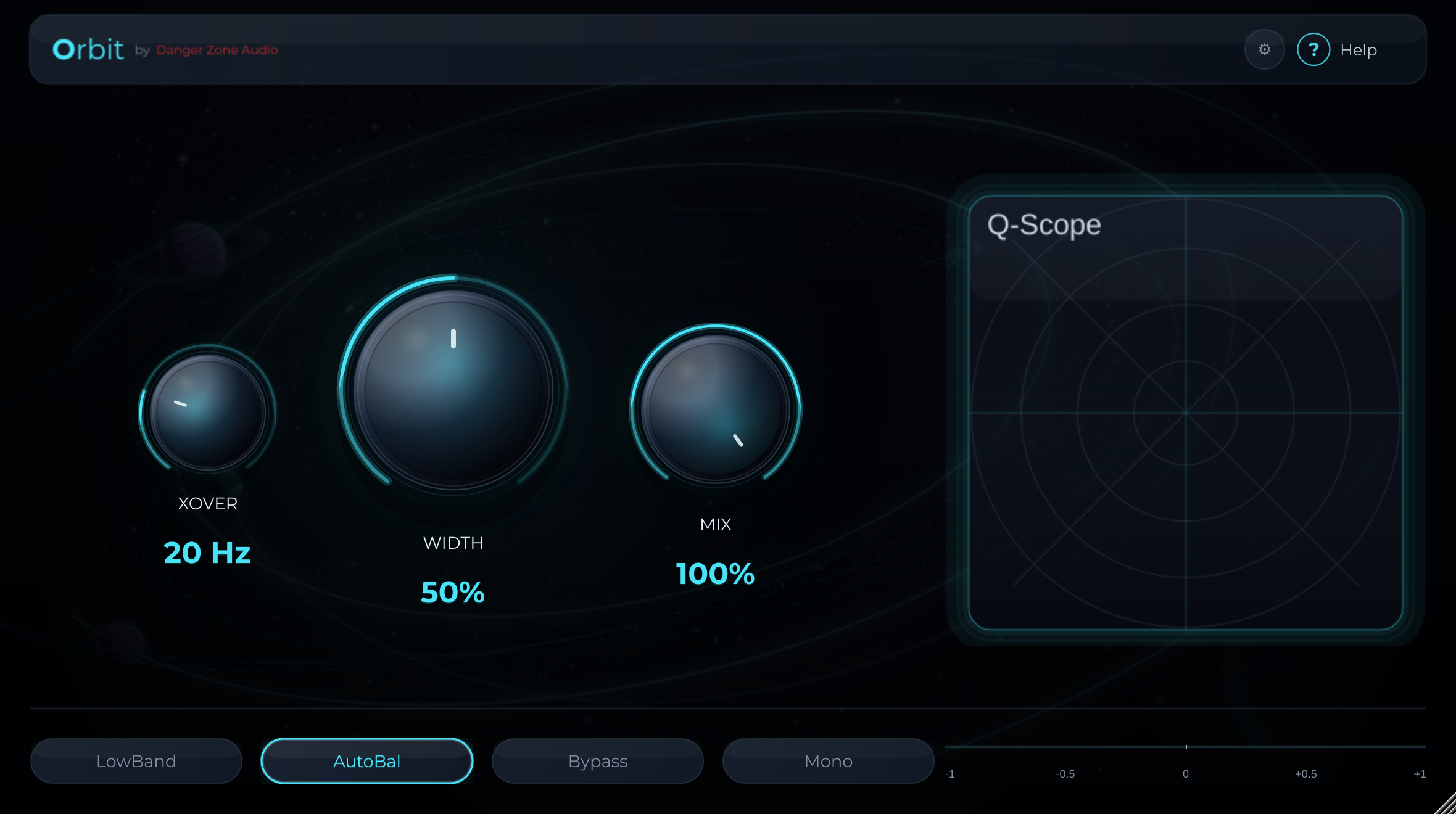
Stereo Widener Plugin
Orbit uses a Hilbert transform to push your mix wider without wrecking the low end or breaking mono compatibility.
Features
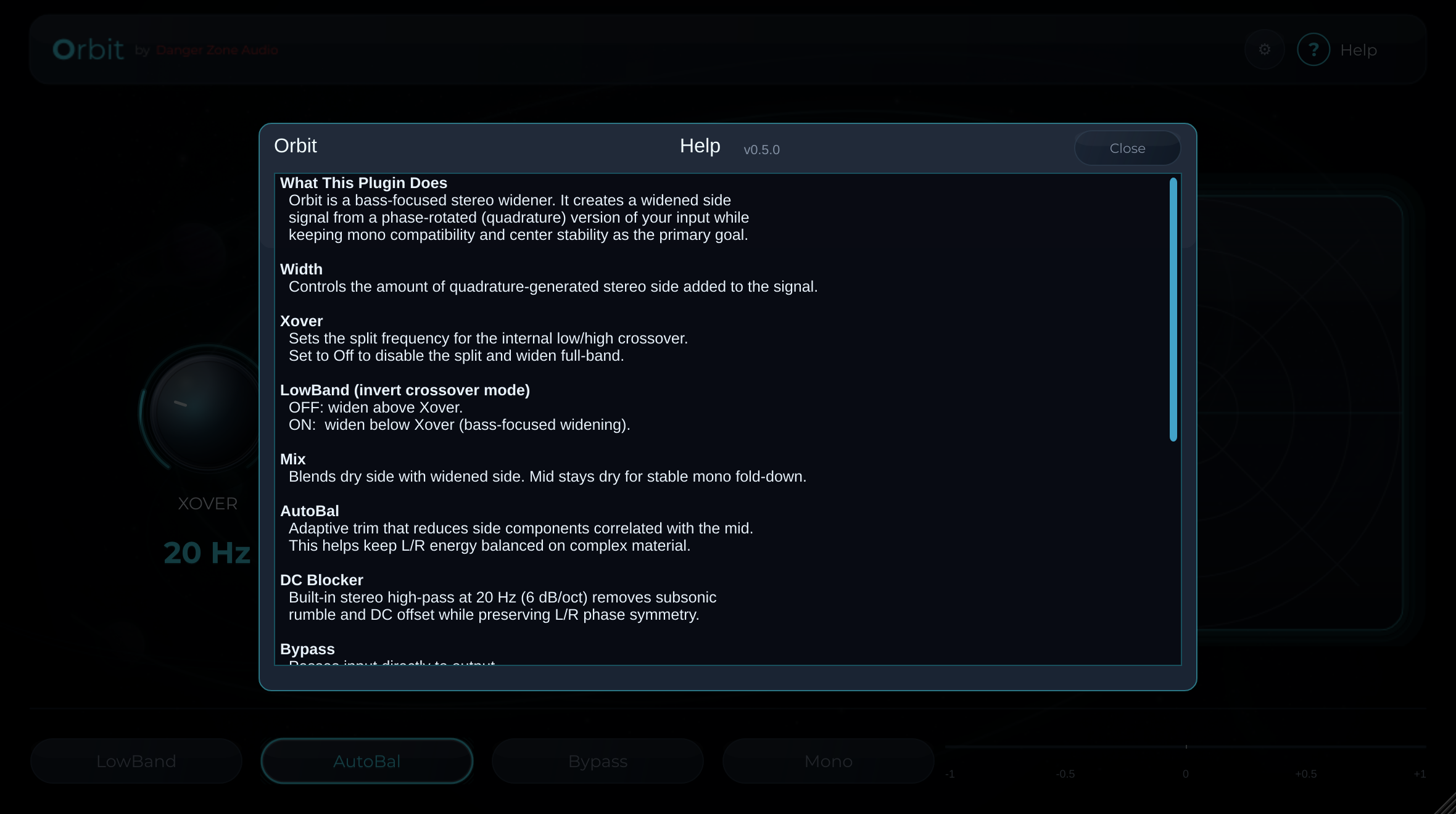
12th-order Hilbert transformer generates true quadrature stereo width that survives mono summing. No delay tricks, no comb filtering.
Linkwitz-Riley 4th-order crossover keeps low frequencies centered and club-compatible. Set the boundary, protect your bass.
Dry mid signal is preserved untouched. Toggle Mono Monitor to verify your fold instantly.
Projection-based L/R correction reduces energy drift on complex, harmonically rich sources. Keeps your image centered.
Built-in phosphor-decay Lissajous display with gain control. See your stereo image in real time.
Blend dry and widened signal at any ratio with mid preservation at every setting. Click-free crossover automation.
Flip the crossover to widen below instead of above. Experimental sound design for low-frequency stereo movement.
73+ DSP regression tests validate every build against sine, saw, square, triangle, detuned, and FM sources.
Built-in Help
Tap the ? button at any time for a plain-English explanation of every parameter, the Q-Scope, and the correlation meter, all without leaving the plugin.
Workflow
Drop Orbit on a bus, track, or master. It runs as a VST3 plugin in any compatible DAW.
Choose where widening begins. Low values protect only sub-bass. Higher values keep more of the low-end centered.
Turn up Width to taste. Watch the Q-Scope spread. Check mono. Done.
Under the Hood
Most stereo wideners use delay, pitch shifting, or mid/side EQ to create the illusion of width. These methods can hollow out the center, smear transients, or cause phase cancellation when summed to mono.
Orbit uses a 12th-order IIR Hilbert transformer to generate a true 90-degree quadrature signal. The widening stays phase-stable because it comes from a mathematically defined side signal, not from timing tricks. Your dry mid stays untouched, and only the generated side content is blended in.
Get Notified
Be first in line when Orbit launches. Drop your email and we'll let you know the moment it's ready.
Launch pricing: $29 introductory, then $49 regular
No spam. Just a single email when we launch.